
Watch the recording of the webinar:
Listen to the recording via our podcast:
View the Slides:
Alternative download (PDF)
Tracy's poll and responses (see the blue number to the right of each option):
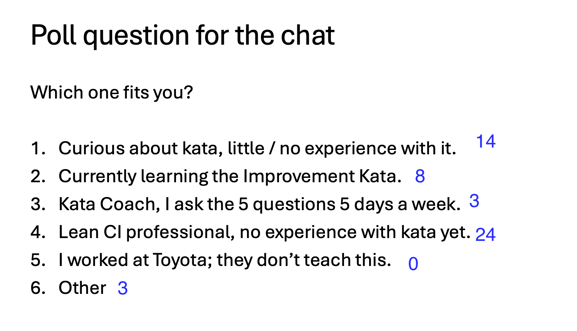
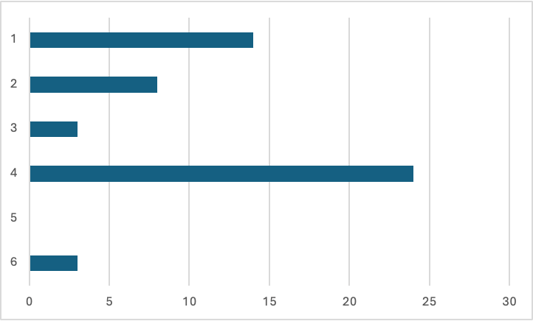
Most leaders have been told to coach without ever being coached themselves, without a clear framework, and without a community of practice to support them. The result is the pattern Tracy DeFoe describes near the start of this session: a manager pushed out of an airplane and not entirely sure how the parachute works.
This webinar is for that person — and for anyone who recognizes that coaching is a learnable, practiceable skill rather than something some leaders are simply born with. Tracy is an adult educator with about 40 years of experience teaching adults at work, and a Kata coach with more than a decade of practice. She co-founded Kata Girl Geeks, co-founded Kata School Cascadia, and facilitates Tilo Schwarz's Kata Coaching Dojo Masterclass. The framing she brings to coaching skill development is grounded in research, deliberate practice, and the honest reality that most people who try to coach are doing it without enough support.
The session walks through what coaching is and isn't, why having a framework matters, and the three paths to getting better at it: on your own, with a buddy or second coach, and in community.
Tracy's working definition: coaching is when one person helps another person grow and develop — their work skills, life skills, and possibly their scientific thinking habits. The intention is what defines it. The mechanics serve the intention.
What coaching is not: telling. Tracy is direct on this. Telling someone what you would do in their situation is not coaching them. She illustrates with a story from her friend Deondra Wardelle, who had worked in an environment where "coaching" went like this: someone would walk up and say "I hear you've been assigned this task — can I coach you?" and then proceed to tell her exactly what to do, drawing on what had worked before.
That isn't coaching. That's instruction wearing a coaching label. Coaching is harder, more deliberate, and more human. It's also harder to fake.
Tracy's point that lands: telling isn't teaching either. The reflex to tell people what to do — even when we genuinely want to help — is the most common obstacle to becoming an effective coach. Breaking that reflex is the first developmental task most new coaches face.
The framework Tracy uses is the Coaching Kata paired with the Improvement Kata, developed by Mike Rother through his research into Toyota's management practices in the early 2000s.
Mike's two research questions are the spine of this body of work. First: what are the unseen managerial routines and thinking that lie behind Toyota's success with continuous improvement and adaptiveness? Second: what can other organizations do to develop similar routines and thinking?
The first question came from a frustrating pattern Mike and Jeff Liker had observed. They would visit a company, document the lean tools the company had implemented, write about them, leave — and return months later to find the kanban boxes dusty, the workarounds proliferating, and the tools effectively abandoned. The lean tools weren't the issue. Something underneath the tools was missing.
The Kata answers what was missing: structured routines for thinking and behavior that, when practiced deliberately, develop into habits and capabilities. The word "kata" comes from martial arts and means both "way" and "practice routine" — simple structured patterns you practice deliberately, with the intention of building habits and developing new abilities at the same time.
The Improvement Kata is a four-step pattern the learner practices: understand the challenge, grasp the current condition, establish the next target condition, and experiment toward the target. The Coaching Kata is the matching pattern of structured questions the coach asks the learner daily at the storyboard. Both sides have a defined structure. Both sides know what the other is doing. The transparency itself is part of why it works.
Tracy's argument: it's pretty hard to freestyle your coaching, especially if you don't have the lived experience of having been coached well. Without a framework, coaches default to the patterns they've absorbed — usually telling, usually well-intentioned, usually not very effective.
A useful framework has three things. First, a structure or pattern you can practice. Second, a reference for what good or great looks like — because without a reference, you can't tell whether you're improving. Third, support — a community to practice with, learn from, and stay accountable to.
There are many published coaching models. Tracy mentions the GROW model and notes that a quick search will return anywhere from four to seventeen "popular" frameworks depending on which result you click. The specific framework matters less than having one. The Coaching Kata is the one Tracy uses and teaches; the principles she draws out apply to coaching skill development more broadly.
A typical Kata coaching cycle has a coach and a learner meeting daily — usually for about 20 minutes in the early stages, dropping to under 10 minutes once the learner gains proficiency. They meet at a storyboard that documents the learner's challenge, current condition, target condition, obstacles, and experiments. The coach uses the Coaching Kata's scripted questions; the learner answers them with reference to the storyboard.
In Tracy's session she shows an example storyboard from a learner named Marisa — digital, neat, with run charts in the current condition section, process blocks describing the work, target condition, evidence of reflection, and an experimenting record with detailed notes on what happened and what was learned. The level of detail isn't typical of every storyboard (most are messier), but it illustrates what the practice can produce when it's done well.
Two things stand out in the practice that aren't immediately obvious from reading the books.
First, the predictability is part of the value. The learner knows what the coach is going to ask. The card is on the storyboard or visible on screen. There are no surprises. And yet, despite knowing the questions, learners still find it genuinely difficult to answer them well every day. The structure doesn't make the thinking easier — it makes the thinking visible, which is harder and more useful.
Second, kindness and empathy run through the practice in ways that don't always come across in the written descriptions. Tracy quotes Fortune Bookholdt, a learner from one of her recent groups, who said in a summary reflection: "I have found in the Kata a lot more kindness and empathy than you get from reading the books." That's a genuine observation. The Kata can read on the page like a procedural framework. In practice, when it's done well, it's a deeply human activity.
The core practical content of the session. Tracy organizes it around the title — mine, yours, ours — and walks through what's possible at each level.
On your own. Possible, but hard. Self-study is the slowest path because it's difficult to honestly observe yourself, hard to maintain the discipline of keeping data, and easy to fall into a rabbit hole about what "good enough" looks like without an external reference. Tracy's advice if you're on your own: reflect, keep data, and find a friend as soon as you can. The practice is much more sustainable with even one other person.
With a buddy or second coach. Significantly more effective. A buddy gives you an observer, someone to talk things through, a focused supporter, somebody to practice with, and emotional encouragement. If you don't have a buddy and can't find one, the second-best option is to record yourself coaching and listen to it later — Tracy's note: it will be horrible and embarrassing and humbling, and then you'll delete it, and you'll be a better coach. Hearing yourself talk far more than you thought you did is a productive shock.
In community. The strongest path. A group lets you compare experiences in a safe place, share and hone your reference for what good looks like, find support and goals, and practice with multiple people. Tracy's collaboration with Mark Rosenthal is one example she points to. Kata Girl Geeks is another. Kata School Cascadia is a third. Communities are particularly valuable because they expose you to coaches who aren't exactly like you — different industries, different styles, different blind spots — which sharpens your own practice.
A specific point worth lifting: the pandemic and the arrival of widespread Zoom adoption were unexpectedly good for Kata coaching skill development. Distance stopped being a barrier to community. Coaches around the world can now zoom into a Friday afternoon coaching call, ask questions, share stories, and seek support. You don't have to leave home to find your community.
Drawing on Doug Lemov's Practice Perfect, Tracy is clear that general reflections aren't enough. Casual notes — "that went well" or "I think I improved" — don't actually produce improvement. What produces improvement is specific data on whatever you're trying to get better at.
A few specific things she tracks in her own coaching practice and recommends to others.
Time per coaching cycle. Mike Rother's book says 20 minutes a day. In practice, with new learners it can run up to 30 minutes; with proficient learners it drops under 10. But within the cycle, time should be allocated to the right places. The first three questions (challenge, current condition, target condition) should take a minute or less if the storyboard is current. The bulk of the time should go to the experimenting questions — what did you learn from your last step, what's your next step, what obstacles are in your way. If you're spending seven minutes on the front and three minutes on the back, the cycle is upside down.
Talk time ratio. Coaches' questions are scripted. There's no reason a coach should talk more than about 15% of the time. Most new coaches do — usually because they're nervous, or because they're falling back on the telling reflex. Recording yourself and listening back is the fastest way to confront the actual ratio.
How the cycle starts and ends. Early in Tracy's Kata journey, people commonly said new learners would walk away from coaching cycles frustrated. Tracy's view: that's a sign the coach stopped too soon. Learners should leave at least encouraged to try again, at least feeling listened to, at least with the relationship intact. Tracking how cycles begin and end is a useful diagnostic.
The actual words you said versus what you intended to say. This is what Tracy and Tilo Schwarz spend much of their time on. Many coaches struggle to be sparse with their words and elaborate to the point of confusing the learner or talking too much. Practicing afterwards — what could you have said instead, said in fewer words, said more clearly — is one of the highest-leverage skill-building exercises.
Progress in scientific thinking. Are you and your learner being methodical? Data-driven? Testing hypotheses? Each of those is a tracker.
The point that holds the data discipline together: if you're not specific about what you're trying to improve and what data tells you whether you're improving, your coaching will plateau. Improvement requires the same discipline you'd ask a learner to apply to their work.
A useful section of the session — Tracy walks through the path Kata Girl Geeks (a global women's group she co-founded) uses to develop new coaches. The pattern is generalizable.
First, participate in meetings for a while. Watch live coaching cycles. Develop a feel for what good looks like before trying to do it.
Second, take the role of learner. Even if you arrive saying "I'm already a great Kata coach," start as a learner. Tracy notes this is a great screening question — anyone unwilling to be a learner probably isn't much of a coach. Three challenges as a learner, eight weeks each, completed in a 12-week period. That's six months minimum.
Third, every coach has a second coach. Always. A new coach gets a second coach to support them. A first-time second coach gets a third coach. Support is structural, not occasional.
Fourth, keep learning and sharing.
Tracy is direct about something most lean programs don't say out loud: there is no shortcut. Slow is smooth and smooth is fast. Mike Rother's books suggest you can start coaching in 20 days. In Kata Girl Geeks, when Tracy asked who had started coaching too early, almost everyone raised their hand — they'd started before they were ready and crashed and burned. The slow path is the fast path because it's the one that actually develops the capability.
A question that came up in the Q&A and is worth surfacing because it's the situation many CI leaders are actually in. How do you practice this in an environment where the concepts are unknown?
Tracy's term for it: Kata in secret, or Kata Incognito. You don't have to introduce the whole framework. You don't have to set up a storyboard. You don't have to launch organization-wide training. You just start asking the questions. What were we trying to achieve? What did we do last time? What did we learn from that? Asking the experimenting questions and listening to the answers is itself a coaching practice — even without any formal Kata infrastructure around it.
Tilo Schwarz is currently doing work on using Coaching Kata questions in regular meetings as a meeting structure, regardless of whether anyone in the meeting is practicing Kata. That's a useful demonstration: the questions work because they're well-designed questions for developing thinking, not because they require a specific organizational context.
Tracy's note for anyone in this situation: just because you're the only one in your company doesn't mean you have to be alone. A buddy or community elsewhere — through Kata Girl Geeks, Kata School Cascadia, or any of the other Kata schools that now exist around the world — gives you the support you can't get from your immediate environment.
A second Q&A point worth lifting. Tracy was initially convinced remote Kata coaching wouldn't work — that the body language, physical proximity, and shared focus on a physical storyboard were essential. The first person she coached remotely was Deondra Wardelle, who lived too far away for in-person coaching. Tracy tried it. It worked.
The adjustments that make remote coaching effective: a digital storyboard both coach and learner can see in real time, or daily photos of a physical storyboard. When the cycle calls for a "let's go look at the process together" moment that's harder remotely, the learner can start a video call on their phone and walk the coach through what they're seeing. Tracy notes that even when people are in the same building now, they often dial in over Teams. The line between in-person and remote coaching has become less meaningful than it was.
Worth surfacing because it captures something about Tracy's approach that the rest of the page doesn't.
Kata School Cascadia's mascot is a Yeti named "I Don't Know Yeti." The origin: a conversation about how powerful the word "yet" is when someone says "I don't know." The phrase "I don't know yet" preserves the door to learning. The threshold of knowledge — the place Mike Rother calls the learning zone — is where the Kata work actually happens. Mark Rosenthal suggested the mascot should be a Yeti, and the name stuck.
The point underneath the joke: getting comfortable saying "I don't know yet" is part of what makes coaching effective, both for coaches and for learners. The mascot is a reminder that the practice is supposed to be fun, that learning is the point, and that no one — including experienced coaches — is supposed to have all the answers.
A few specific things the platform does that connect to coaching practice.
KaiNexus tracks improvement work in a way that lets coaches see the full arc of a learner's experiments — what was tried, what was learned, what came next. The kind of historical visibility Tracy mentions in passing as useful for sustained coaching becomes systematic in the platform rather than dependent on individual notebook discipline.
The platform supports the kind of cascading visibility that distributed coaching practices need. When coaches and learners are at different sites or even different organizations, having a shared place where the work is visible matters more than the format of any particular storyboard.
For organizations trying to develop coaching capability at scale — moving from one or two people who coach well to a broader culture of coaching — the infrastructure underneath the practice matters. KaiNexus is built for that.
Tracy DeFoe is an adult educator specializing in learning at work. About ten years ago she started coaching to develop a scientific mindset in people improving their processes at work using the Improvement and Coaching Kata detailed in Mike Rother's Toyota Kata books. She is co-founder of the global women's group Kata Girl Geeks, co-founder of Kata School Cascadia, and a facilitator with Tilo Schwarz's Kata Coaching Dojo Masterclass. She is president and chief education officer of TLFI, The Learning Factor.
What is coaching, and what's the difference between coaching and telling?
Coaching is when one person deliberately helps another person grow and develop — their work skills, life skills, and thinking habits. The intention is what defines it. Telling — saying "here's what I would do" or "here's what's worked before" — is not coaching, even when it's well-intentioned. Coaching uses questions to help the learner develop their own thinking; telling provides the answer and ends the learning. The reflex to tell is the most common obstacle for new coaches, and breaking it is the first developmental task most coaches face.
What are the Improvement Kata and the Coaching Kata?
The Improvement Kata is a four-step pattern the learner practices: understand the challenge, grasp the current condition, establish the next target condition, and experiment toward the target condition through rapid PDCA cycles. The Coaching Kata is the matching set of structured questions the coach asks the learner daily at the storyboard. Both come from Mike Rother's research into the unseen managerial routines that produce Toyota's continuous improvement results, detailed in his books Toyota Kata, The Toyota Kata Practice Guide, and Toyota Kata Culture.
Why does coaching require a framework?
Because coaching without a framework defaults to the patterns the coach has absorbed elsewhere — usually telling, usually well-intentioned, usually not very effective. A useful framework gives you a structure to practice, a reference for what good looks like, and a foundation for getting better. There are many coaching frameworks (GROW, Coaching Kata, and others). The specific framework matters less than having one.
How do you actually get better at coaching?
Through deliberate practice with specific data. General reflections — "that went well" or "I improved" — don't produce improvement. Tracking specific things does: time per coaching cycle and time per question, talk-time ratio (a coach should talk no more than about 15% of the time), how cycles start and end, the words you actually said versus what you intended to say, and progress on scientific thinking. The fastest path is with a buddy or in a community. Going alone is possible but significantly slower because it's hard to honestly observe yourself.
Can you practice Kata coaching if your organization doesn't know about Kata?
Yes. Tracy calls it "Kata in secret" or "Kata Incognito." You don't have to introduce the framework formally, set up storyboards, or launch training. You can start by asking the Coaching Kata questions in regular conversations and meetings — what were we trying to achieve, what did we do last time, what did we learn. The questions work because they're well-designed for developing thinking, not because they require a specific organizational context. Just because you're the only one in your company doesn't mean you have to be alone — buddies and communities exist outside any one organization.
Does Kata coaching work remotely?
Yes, despite Tracy's initial skepticism. The adjustments: a shared digital storyboard or daily photos of a physical one, video calls for moments that would normally involve walking to the process together, and explicit communication about what the second coach should be watching for in any given session. The line between in-person and remote coaching has blurred to the point where many coaches now run cycles entirely on Zoom even when both parties are in the same building.
How long does it take to become a competent coach?
In Kata Girl Geeks, the path runs about a year for a new coach starting from scratch — including six months as a learner before beginning to coach, with a second coach supporting every new coach throughout. Mike Rother's books suggest you can start coaching in 20 days, but Tracy's experience is that most people who started that early crashed and burned. The slow path is the fast path. Slow is smooth, and smooth is fast.




.svg)



Copyright © 2026
Privacy Policy