
Watch the recording of the webinar:
Bonus info:
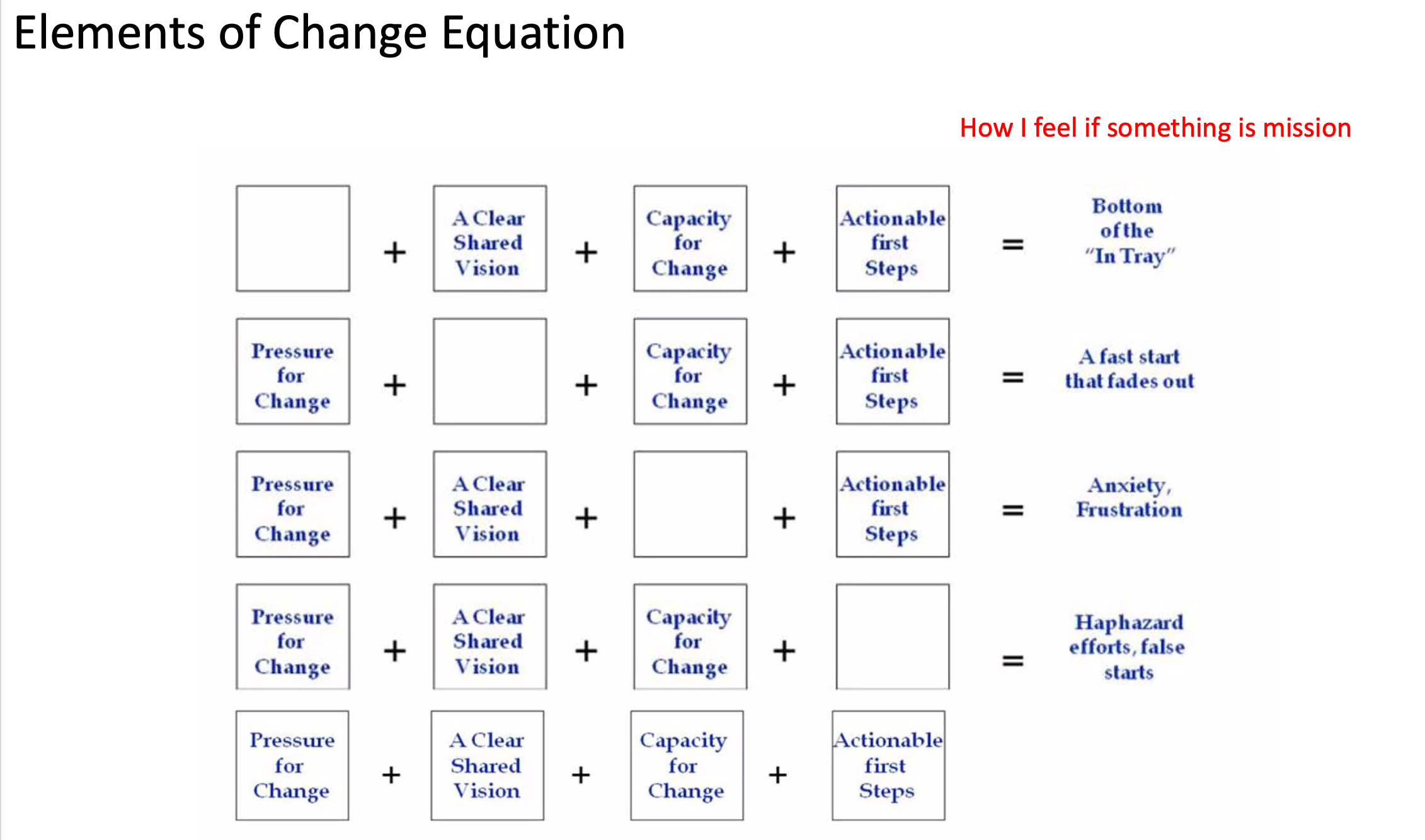
A change model that Scott said he would share (click to view a larger version):
Listen to it as a podcast:
Slides (PDF) here (view or download via SlideShare):
Tasha Eurich studied roughly 5,000 people on self-awareness. The headline finding from her work — which she covers in detail in her TEDx talk — is that 95 percent of people consider themselves self-aware, but only about 10 to 15 percent actually are.
Scott Burgmeyer opened the session with that gap, because it frames everything else he covered. The disconnect isn't that people are lying to themselves. It's that they're measuring the wrong thing. Self-awareness, in the sense that matters operationally, has two components. The first is understanding yourself — your drives, your tendencies, your defaults. The second is understanding how those drives land on other people. Most people do the first part reasonably well. The second part is where the gap lives, and the gap is what produces most of the friction in continuous improvement work, in change initiatives, and in cross-functional collaboration.
The mechanism Scott walked through is straightforward. We intend to be a particular way — persistent, decisive, persuasive, supportive. The list of positive self-descriptions is the one we'd happily own. But our drives, when they're strong enough, can land on the people around us as something different. Persistent becomes pushy. Decisive becomes harsh. Persuasive becomes manipulative. The drive doesn't change. The reception does. And without a way to see what we're projecting, we keep behaving the same way and keep being received in ways we didn't intend.
The session was built around a brief behavioral assessment Scott invited attendees to take during or before the webinar. The assessment measures four drives — dominance, extraversion, patience, and formality — and produces a report that Scott then walks through interpretively. The framework borrows heavily from the Predictive Index. The value of the session isn't the assessment itself. It's Scott's coaching on what to do with the data, especially around communication style, taking action, and identifying where a team has structural blind spots that no individual can fix alone.
Scott Burgmeyer is executive director of IQC and has worked and consulted in manufacturing, technology, education, and healthcare industries for over 30 years. He has held roles including QA Manager, CI Manager, Organizational Development, Human Resources, SVP of Quality & Improvement, and Chief Improvement Officer. He is a Master Black Belt and the creator of The DMAIC Way. He is a lifelong learner, professor, speaker, and author of multiple books, articles, and journal publications. His professional purpose, summarized on his office wall behind him during the session: Make it Better! Make it Stick!
The framework rests on four behavioral drives, each running along a continuum from low to high. None of the positions on any continuum are good or bad. They just are. What matters is knowing where you land, what the strengths and blind spots are at that position, and how much energy it takes you to flex outside your natural state.
A — Dominance. How you generate and value ideas. People high in A like their own ideas best, want to put their fingerprint on the work, and find conflict tolerable or even useful. People low in A are collaborators, want the best idea regardless of source, and find conflict stressful. At the far edges of the continuum, a very high-A person will pick a fight on a Tuesday afternoon for fun, and a very low-A person will avoid any disagreement at almost any cost.
B — Extraversion. How you best communicate. People high in B process out loud, want face time, love to brainstorm verbally, and energize themselves through conversation. People low in B process internally, want time to think before speaking, and find sustained interpersonal energy depleting rather than energizing.
C — Patience. The work environment and pace you prefer. People high in C stay on task, finish one thing before moving to the next, and operationalize work consistently. They're the marathon runners. They make organizations scalable. People low in C are makers of change — they want twenty or thirty or fifty things going on at once, get bored without that variety, and are excellent sprinters but often poor finishers.
D — Formality. Your basis for judgment, especially around rules. People high in D want details, equal enforcement of rules, and a black-and-white interpretation of policy. People low in D treat rules as guides or suggestions, want executive summaries rather than details, and see the world in gray.
Each drive is a continuum, not a category. The further from the center, the more intense the drive — Scott's framing was that a drive close to center is whispering in your ear, a drive further out is talking, and a drive at the extreme edge is yelling. The closer you are to the midline on any drive, the easier it is to flex left or right. The further out, the more energy it takes to operate outside your natural state.
The assessment produces three patterns for each person.
Self. Your underlying DNA. The science suggests this is largely locked in by age 20 or 21 and doesn't shift meaningfully over time. The general shape persists across your life. The drives may widen slightly with age, the way bodies do, but the fundamental pattern stays put.
Self-concept. Who you think you need to be right now. This pattern reflects what's been going on in your life over the past 90 to 120 days. It changes. It responds to recent feedback, a new role, a new boss, or a particular performance review.
Synthesis. The mathematical combination of the first two. This is roughly what other people experience when they interact with you — the observable version of how you're showing up at the moment.
For most operational conversations about your own behavior, Scott focused on the self pattern. It's the most stable and the most diagnostic of what your natural defaults look like. The other two are useful for coaching conversations and for spotting when someone is flexing under pressure in ways that may be costing them more energy than they realize.
When self and self-concept diverge significantly — Scott's threshold was when one crosses the midline relative to the other — that divergence is statistically meaningful and worth a conversation. Usually it means the person is responding to something specific. A new role. A new boss telling them they need to be more directive. A performance review that flagged a perceived gap. The flexing isn't free, and over time it produces exhaustion if the gap stays open without being acknowledged.
A central operating principle throughout the session was that you can flex any of these drives, but flexing has a cost. The cost varies based on direction and distance.
Flexing in any single dimension — left or right on the same drive — is comparatively easy if you're near the center. The closer to the midline, the cheaper the flex. Someone with a slightly-high A can flex to slightly-low A without much friction. Someone with a far-right A trying to operate as if they had a far-left A is exhausting themselves all day.
Flexing diagonally — across two drives at once — is structurally harder. Scott used the example of someone with a B over A pattern (highly extraverted, comparatively collaborative) who needs to communicate as if they were the opposite: directive, terse, low on people-orientation. That flex isn't just stylistically uncomfortable. It cuts against two simultaneous drives, and the energy cost compounds.
The practical implication is that flexing isn't bad. It's necessary. We all do it daily, sometimes deliberately and sometimes because the situation demands it. The discipline is to know when you're flexing and choose to do it for the right reasons, rather than absorbing the cost unconsciously until you're exhausted and resentful. Scott's framing: "We're the same person. We just choose to behave differently because of our situation." That's fine. What's not fine is doing it without seeing yourself doing it, because the cost still gets paid even when it's invisible.
Scott walked through a four-quadrant model of communication built from the A, B, and C drives. The vertical axis is whether A is higher than B (telling, persuading) or B is higher than A (connecting, respecting). The horizontal axis is low C versus high C.
Telling — high A, low B, low C. Direct, brief, action-oriented. The bottom line up front. Bullet points. Make the decision and move on.
Persuading — high A, high B, low C. Verbal, energetic, opinionated. Builds the case out loud. Wants to convince.
Connecting — low A, high B, high C. People-focused, patient, relational. Wants to know how the change affects the team. Asks about impact on individuals.
Respecting — low A, low B, high C. Quiet, deliberate, considered. Wants time to think. Prefers structure and reflection.
The position on the diagram tells you two things: your default communication style and what's easiest or hardest for you to flex toward. Adjacent quadrants are reachable. Diagonal quadrants are expensive. A natural Teller can flex into Persuading without much friction. The same Teller trying to flex into Connecting — slowing down, focusing on people, processing relationally — is fighting two drives at once.
The team-level application is where this gets most useful. If you map a team across the four quadrants and discover that nobody is in Respecting, the team has a structural blind spot. Decisions are being made without enough quiet reflection. Someone is going to need to play the Respecting role deliberately, even if it's not their natural state, because the team doesn't have anyone for whom it is natural. Scott's framing: identify the gap, assign someone to flex into it, and make the assignment explicit so the person knows they're being asked to do something that costs them energy.
The peer principle Scott highlighted is worth keeping. When you're a leader, flexing to your direct reports' natural styles boosts their engagement and clarity — your job is to meet them where they are. When you're a peer, the discipline is to meet in the middle rather than constantly flexing toward the other person, because constant one-sided flexing produces resentment over time. And when you're communicating to a group, the discipline is to deliberately hit multiple quadrants so the people in each one feel addressed.
Scott built a second quadrant model around how people take action, this time using the relationship between A and C combined with the D drive.
Innovator — A higher than C, low D. Generates lots of ideas, low respect for established process, comfortable proposing changes to proven systems. The classic question: "Why do we do it that way?"
Maverick — A higher than C, high D. Has ideas, wants details, drives toward decisions within structured frameworks. Combines initiative with rule-orientation.
Implementer — C higher than A, high D. Operationalizes the work, finishes what gets started, attends to detail. The person who turns ideas into reality.
Coordinator — C higher than A, low D. Patient, flexible, oriented toward consensus and collective movement. Brings the team along.
The same logic applies as in the communication quadrants. Team-level mapping reveals structural gaps. A team made entirely of innovators will generate brilliant ideas and finish nothing. A team made entirely of implementers will execute reliably and never propose anything new. A team without a commander — someone willing to say "this is how we're going to do it" — will debate indefinitely.
Scott's working coaching move is to identify which lever the team currently needs and pull on the right person at the right time. When the team needs ideas, lean on the innovators — and then turn off the idea spigot when there's enough to work with, which is itself a skill innovators have to develop. When the team needs to converge on a decision, ask whoever has commanding tendencies to step into that role even if it's uncomfortable. When the team needs to bring everyone along, ask the coordinator to take that lead. When the team needs to actually finish, get the implementers fully engaged and protect them from further innovation cycles.
Scott was direct about a personal example: he's a low-D innovator with a tendency to say "doing it the same way is silly, we should try something different." He knows this drives implementers crazy. He also knows that asking him to proofread a document is the wrong assignment — it cuts against his natural state and produces worse output than asking an implementer would. The self-awareness isn't about changing who he is. It's about knowing which roles he should and shouldn't take on, and which roles he should hand to someone whose natural state matches the work.
A question came in about whether organizations should hire for behavioral fit — looking for people similar to the existing team, or deliberately looking for people who are different.
Scott's framing was that the behavioral assessment is the "head" piece of a three-part picture: head, heart, and briefcase.
Briefcase is the easy part to check. Skills, education, background, certifications. The visible credentials. If you hire on briefcase alone, the research suggests you're roughly 10 percent predictive of fit and success.
Heart is cultural fit. Do they fit the organization's culture? Do they fit the team they'll join? Do they have a positive relationship with the boss they'll report to? Does the job itself fit their natural style?
Head is the behavioral pattern this framework measures, plus cognitive capability — which Scott described as not how big the sponge is (that's IQ) but how fast the sponge will absorb (that's learning speed).
Blending all three produces roughly 85 percent predictive accuracy. The head piece on its own isn't enough. Hiring people who all have the same behavioral pattern produces a homogeneous team with predictable blind spots. Hiring people whose patterns deliberately complement existing gaps produces a team that can flex across more situations — but only if the team knows about the patterns and can deploy them deliberately.
For leadership roles specifically, Scott offered an honest stereotype: senior executives tend to skew high A, high B, low C, low D. The pattern reflects what executive roles require — initiative, communication, multiple competing priorities, comfort with ambiguity in rules. But the pattern isn't the requirement. The requirement is the capability. Someone with a different pattern can succeed in an executive role if they understand where their natural state will need to flex and what that flexing will cost them. Hiring decisions that go strictly on pattern matching miss the candidates whose self-awareness about their pattern makes them better leaders than candidates who match the stereotype but don't know themselves well.
Another question that came up was how to drive effective change management when leadership doesn't support the change.
Scott's answer was structural. Change management starts with agreement that there's a problem. Without that agreement, no model and no technique will work. If you and your leadership disagree on whether there's a problem worth changing, your first job isn't change management — it's surfacing the problem in terms they can recognize.
The behavioral framework helps with the second step. If you know your leader's pattern — high C and high D, say — you know how to bring the problem to them. They'll want details. They'll want a clear case for why the current state is broken. They won't be moved by emotional appeals or general statements that things could be better. They need the specific gap in operational terms, with the data to support it.
If they're a different pattern — low A and high B, say — the same problem needs a different framing. They'll want to know how the change affects people. They'll want to talk it through. They'll want the discussion before the decision.
The framework doesn't eliminate the work of change management. It tells you which change management approach will actually land with the specific leader you're trying to move. The same problem, framed three different ways, will succeed or fail based on whether the framing matches the receiver's natural state.
The behavioral work Scott described — knowing your pattern, understanding your blind spots, flexing deliberately, mapping team gaps — is human work that no software performs on a person's behalf. The self-awareness has to come from the person. The flexing has to come from the person. The decision to step into an uncomfortable role because the team needs it has to come from the person.
What infrastructure does is reduce the structural friction that makes that human work harder. When team improvement work runs through a shared system rather than scattered across email and meetings, the patterns Scott describes become more visible. A team that consistently struggles to finish what it starts isn't a mystery — it's a team with no implementers, or with implementers who keep getting pulled into innovation work that isn't theirs. A team where good ideas don't surface isn't a problem of imagination — it's a team without anyone playing the Respecting role, where decisions get made too quickly for quiet reflection to happen.
The communication quadrants apply just as directly. A CI leader who is naturally a Teller writes their improvement updates as bullet points and bottom-line conclusions. The Connectors on their team experience those updates as cold and feel disengaged from the work. The Respectors experience them as rushed and feel pressured into decisions they haven't had time to consider. Knowing the team's patterns and writing communications that hit multiple quadrants is the kind of small deliberate flex that makes broad participation actually happen.
None of this changes the underlying argument. The self-awareness work is the work. What infrastructure does is make the patterns visible enough that the work can be applied deliberately at the team level, not just the individual level.
Why are most people not actually self-aware? Tasha Eurich's research found that 95 percent of people believe they're self-aware, but only about 10 to 15 percent actually are. The gap isn't dishonesty. It's that most people measure self-awareness only on the first half — understanding themselves — and miss the second half, which is understanding how their behavior lands on other people. Without feedback on the second half, you can be entirely accurate about your intentions and entirely wrong about your impact.
What are the four behavioral drives in this framework? A is dominance — how you generate and value ideas. B is extraversion — how you best communicate. C is patience — the work environment and pace you prefer. D is formality — your basis for judgment, especially around rules. Each drive runs on a continuum from low to high. There are no good or bad positions. There are just positions with different strengths and different blind spots.
What's the difference between the self, self-concept, and synthesis patterns? Self is your underlying DNA, largely locked in by age 20 or 21. It doesn't change much over your life. Self-concept is who you think you need to be right now, reflecting what's been going on in the past 90 to 120 days. It changes in response to feedback, new roles, or specific situations. Synthesis is the mathematical combination — roughly what other people experience when they interact with you. For most operational conversations about your defaults, the self pattern is the diagnostic one. The other two are useful for coaching conversations and for spotting when someone is flexing under pressure.
What does it mean to "flex" a behavioral drive? To operate temporarily outside your natural state. Flexing single dimensions — moving slightly more directive when the situation calls for it, slowing down to listen when someone needs that — is comparatively cheap if you're near the center on the drive in question. Flexing diagonally across two drives at once is expensive and exhausting. The discipline isn't to avoid flexing. It's to know when you're doing it, do it for the right reasons, and not absorb the cost unconsciously until you're depleted and resentful.
What are the four communication quadrants? Telling (high A, low B, low C) is direct and action-oriented. Persuading (high A, high B, low C) is verbal and energetic. Connecting (low A, high B, high C) is people-focused and patient. Respecting (low A, low B, high C) is quiet and deliberate. Each quadrant represents a default communication style and the styles that are easiest or hardest to flex toward. Adjacent quadrants are reachable. Diagonal quadrants take significantly more energy.
How do you adjust communication for someone whose style is different from yours? Flex toward their natural style, not yours. A Teller talking to a Connector should slow down, talk about people, and let the conversation breathe rather than driving to a bullet-point conclusion. A Connector talking to a Teller should skip the relational warm-up and lead with the bottom line. The receiver's natural style is also the style they prefer to receive. When the message reaches them in their natural style, they engage. When it reaches them in someone else's natural style, they disengage even if the content is identical.
What's the peer principle for flexing? When you're a leader, flexing to your direct reports' styles is your job — it boosts their engagement and clarity. When you're a peer, the discipline is to meet in the middle rather than constantly flexing toward the other person. One-sided flexing across long peer relationships produces resentment over time. The other person feels like the burden of accommodation is shared. They aren't paying half of it.
What are the four action quadrants? Innovator (high A, low C, low D) generates ideas and challenges established process. Maverick (high A, low C, high D) drives initiative within structured frameworks. Implementer (low A, high C, high D) operationalizes and finishes work. Coordinator (low A, high C, low D) builds consensus and brings the team along. A team needs all four functions, even if it doesn't have one of each. When a function is missing, someone has to flex into it deliberately, which is more expensive than letting a natural fit do it.
How do you map a team's blind spots using this framework? Plot each team member onto the quadrant diagram and look for empty quadrants. If nobody is in Respecting, the team makes decisions too fast and skips reflection. If nobody is in Coordinator, the team can't build consensus easily. If nobody is in Implementer, the team finishes nothing. The blind spots are usually invisible until they're mapped, because the team's existing members keep doing what's natural to them and don't notice what no one is doing.
How should this framework affect hiring decisions? Behavioral pattern is the "head" piece of a three-part picture: head, heart, and briefcase. Briefcase (skills and credentials) on its own is roughly 10 percent predictive of success. Adding heart (cultural fit, team fit, fit with the boss, fit with the role) and head (behavioral pattern and learning speed) pushes that to roughly 85 percent. Hiring exclusively on pattern matching produces homogeneous teams with predictable blind spots. Hiring deliberately for complementary patterns — while still validating cultural fit — produces teams that can flex across more situations.
How does this framework help with change management when leadership isn't aligned? By telling you how to bring the problem to your specific leader. A high-C, high-D leader needs details and a clear operational case for change. A low-A, high-B leader needs to talk it through and understand the impact on people. A high-A, low-C leader needs the bottom-line case and the decision. The same problem framed three different ways will land or fail to land based on whether the framing matches the receiver's natural state. Change management isn't a single technique. It's matching the technique to the person you're trying to move.
What's the difference between strengths and blind spots in this framework? They're often the same trait at different intensities. A high-A's strength is initiative and decisiveness. The blind spot is steamrolling collaborative input. A high-C's strength is patient execution. The blind spot is reaching a breaking point after sustained pressure without expressing it earlier. A low-D's strength is comfort with gray areas and creative interpretation. The blind spot is missing the cases where rules genuinely matter. The trait isn't bad. Over-reliance on it without awareness of the blind spot is what produces problems.
![[Watch Now] How to Leverage Lean for Long-Term Success](https://no-cache.hubspot.com/cta/default/326641/eb5ac7b8-b040-48b7-810e-1589561ffff9.png)





.svg)



Copyright © 2026
Privacy Policy