
Value stream mapping (VSM) is a Lean management method for understanding and improving the end-to-end flow of a product, service, or information from a customer request to its fulfillment. It brings the major work steps, handoffs, information flows, processing times, and waiting times into one view.
VSM helps teams see why work takes as long as it does and where the system makes it difficult to deliver what customers need. The approach applies to manufacturing, healthcare, logistics, financial services, software development, government, and administrative work. What flows through the value stream may be a physical product, a patient, an application, an order, or a piece of information.
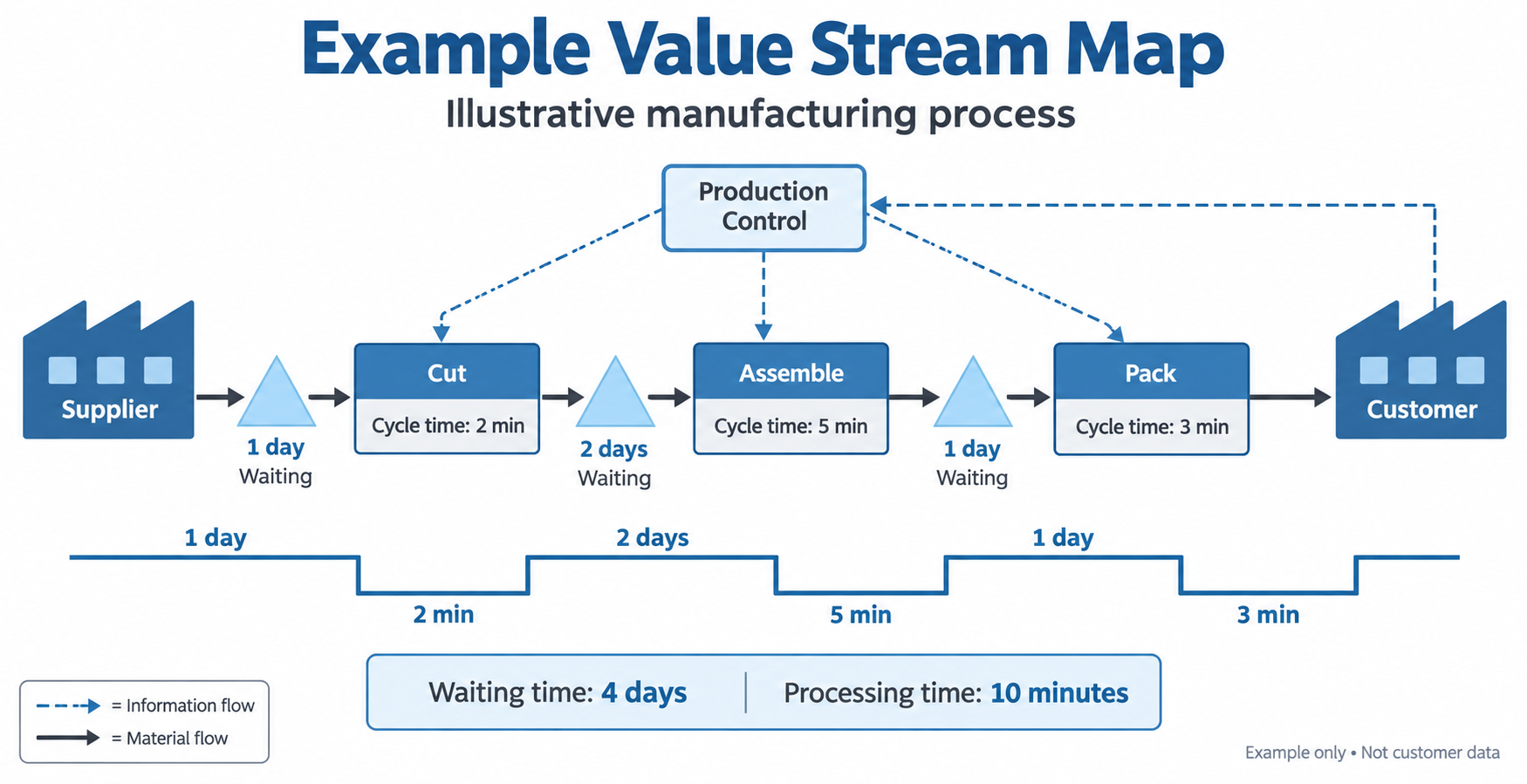
AI-generated illustration with fictional data. This simplified manufacturing example separates material flow from information flow and compares waiting time with processing time. View the full-size map in a new tab.
A detailed process map helps a team understand the steps within a particular activity. A value stream map usually takes a broader view across functions and departments. It shows how work moves through the system, what information triggers or supports that work, and where it waits.
For example, a manufacturer might map the flow from order receipt through production and shipment before examining one assembly operation in detail. A hospital might map a patient's journey from referral through treatment, then use a detailed process map to study registration. Both tools are useful; choose the level of detail that helps the team address its problem.
One lesson from Mark Graban's Lean Hospitals applies across industries: strong individual departments do not automatically create a strong overall system. A local efficiency measure can make the customer's experience worse. Larger production batches may reduce changeovers while increasing inventory and delivery delays. Similarly, batching approvals or laboratory tests may save effort in one department while extending the time everyone else waits.
Distinguish total elapsed time, often called lead time, from the time spent processing the work. In the fictional illustration above, three operations require ten minutes of processing, while the waits between them total four days. Reducing a few seconds of processing may matter less than understanding those waits. Also, processing time is not automatically value-added time: some active work may be unnecessary or may correct an earlier error.
Start with a customer or business problem, such as unreliable delivery, long turnaround time, recurring defects, or repeated requests for missing information. Choose a product or service family with a reasonably similar flow, and set clear boundaries. Trying to map every activity in an organization at once can make the effort too broad to guide action.
Include representatives from the functions the work passes through, along with leaders who can address barriers between departments. A facilitator can guide the effort, but mapping should create shared understanding among the people responsible for the value stream. Having one specialist draw a diagram for everyone else misses much of that learning.
Go to where the work happens and follow its path. For digital or office work, observe how requests, records, and decisions move through people and systems. Ask employees about exceptions, interruptions, rework, and workarounds. Verify timing and quality information through observation and data rather than relying only on estimates in a meeting.
As Lean Hospitals emphasizes, a team needs to distinguish how a process actually works from how people believe it works or how it is supposed to work. A current-state map should reflect today's reality, including the inconvenient parts.
Look for queues, duplicated effort, incomplete information, quality problems, and handoffs that interrupt flow. Ask how scheduling, policies, batch sizes, or incentives contribute. Prioritize problems according to their effect on customers, employees, safety, quality, and delivery. Avoid treating the map as a list of people who need to work faster or jumping to solutions before understanding the causes.
Describe how the value stream could work with fewer delays, clearer information, and more reliable handoffs. An ideal-state discussion can help the team challenge assumptions, while a practical future-state map identifies changes it can realistically pursue. Keep quality and safety requirements visible as the team considers ways to improve flow.
Turn the gaps between the current and future states into specific improvement opportunities, experiments, or projects. Assign responsibility, agree on follow-up, and evaluate whether the changes improve performance. Some problems can be addressed quickly; others need coordinated work or a Kaizen event. Update the map as the process changes. Completing the diagram is the beginning of the improvement work.
The following are illustrative applications, rather than reported customer results:
Mapping only from memory, leaving out frontline employees, and collecting more detail than the problem requires can weaken the effort. So can improving one department's numbers while shifting delays or costs elsewhere. Keep the customer's end-to-end experience in view.
Choose a mapping format that supports collaboration. Sticky notes and paper can work well, as can digital tools when participants can contribute effectively. A polished electronic diagram does not replace direct observation, team discussion, or follow-through. Preserve the learning and put effort into testing improvements.
A map can reveal more opportunities than a team can pursue at once. Use it to agree on priorities and coordinate the work required to reach the future state. KaiNexus can support that follow-through by helping teams manage improvement opportunities and projects. Learn more about supporting value stream improvement with KaiNexus.





Copyright © 2026
Privacy Policy