
Recorded Webinar | Continuous Improvement | Lean Management
Mistake-proofing (poka-yoke) is one of the most effective ways to improve quality, safety, and efficiency by preventing errors before they occur. Instead of relying on training, reminders, or vigilance, organizations can design processes that make the right action the easiest action.
In this webinar, Mark Graban shares practical examples from healthcare, manufacturing, and everyday life that show how leaders can reduce risk, strengthen continuous improvement, and support respect for people by improving the system rather than blaming individuals.
Scroll down for slides, audio recording, transcript, and more.
Mistake-proofing (poka-yoke) improves quality, safety, and efficiency by designing processes that prevent errors instead of relying on reminders, training, or vigilance alone. The examples in this session illustrate how organizations across industries reduce risk by making the correct action the easiest action.
Poka-yoke is the practice of preventing mistakes through thoughtful process and product design. Rather than detecting defects after they occur, mistake-proofing either prevents the error entirely or makes it immediately obvious so it can be corrected before harm occurs. This approach shifts responsibility from individuals to systems, reinforcing respect for people and supporting a culture of continuous improvement.
The webinar highlights examples from healthcare, manufacturing, and everyday life, including:
These examples demonstrate that effective error prevention often relies on simple design changes rather than complex solutions.
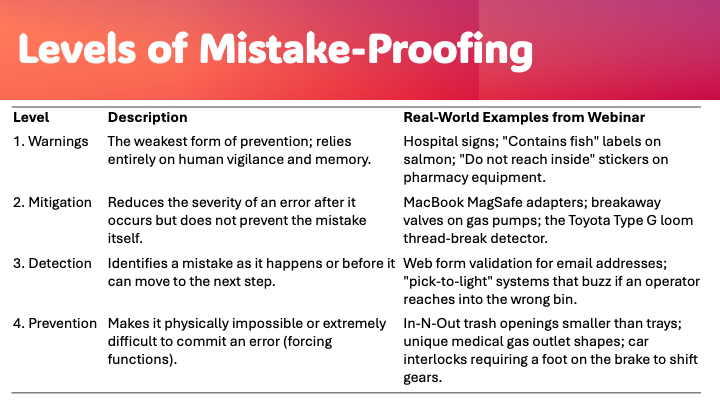
Not all countermeasures are equally effective. The session explains a hierarchy that moves from weaker to stronger approaches:
Organizations that prioritize higher-level solutions achieve more reliable and sustainable improvements.
Mistake-proofing supports continuous improvement by addressing root causes instead of symptoms. When processes are designed to prevent errors, organizations reduce rework, improve safety, and free people to focus on problem-solving rather than firefighting. Leaders play a critical role by encouraging experimentation, learning from mistakes, and involving frontline staff in designing solutions.
Mistake-proofing is not just a quality tool — it is a leadership responsibility.
Human error is inevitable. Systems determine whether those errors become minor inconveniences or serious failures. Organizations that rely on training, reminders, and vigilance alone place an unrealistic burden on people and leave performance vulnerable to fatigue, turnover, and complexity.
Leaders who invest in mistake-proofing reduce risk at the source. Instead of reacting to defects, safety incidents, or customer complaints, they design processes where the correct action is the easiest action.
This approach delivers measurable results:
Mistake-proofing also reinforces a culture of respect for people. When leaders design systems that make success easier and failure harder, they demonstrate that problems are not the fault of individuals but signals to improve the process.
In high-reliability industries like healthcare, aviation, and manufacturing, this shift from blame to system design is what separates organizations that learn from mistakes from those that repeat them.
Ultimately, mistake-proofing allows leaders to move from firefighting to prevention — from managing crises to building resilient systems that perform reliably at scale.

Linda Vicaro: Welcome to today's webinar titled "Mistake-Proofing: Real-World Examples Across Industries". I am Linda Vicaro, the Director of Solutions Engineering and head of the KaiNexus Lean Council here at KaiNexus. I am very happy to be serving as host for today's webinar and am joined by Mark Graban as our presenter.
Mark Graban: Thanks for hosting, Linda.
Linda Vicaro: No problem. I will briefly introduce Mark. Mark Graban is a senior advisor for KaiNexus. Mark has helped organizations improve for almost 30 years, working in manufacturing, healthcare, and software startup settings. He is an author, speaker, and consultant. His latest book, The Mistakes That Make Us: Cultivating a Culture of Learning and Innovation, was recently named a recipient of the Shingo Publication Award. Congratulations, Mark.
Mark Graban: Thank you.
Linda Vicaro: Mark is also the author of the award-winning book Lean Hospitals, as well as Measures of Success: React Less, Lead Better, Improve More. Mark earned a BS in industrial engineering from Northwestern University along with an MS in mechanical engineering and an MBA from the Massachusetts Institute of Technology’s Leaders for Global Operations Program. At this point, I will turn it over to you. Mark and I will be prepared to jump in with some examples as we go along.
Mark Graban: Thank you, Linda, for collaborating on this. We want to share many examples of mistake-proofing from different workplaces and the world around us—things we might take for granted. The best mistake-proofing is often subtle; it just works, and we do not notice or appreciate it.
Mark Graban: I want to provide some grounding in the background of the Toyota Production System (TPS) or Lean to set the stage for these examples. Pictured here is the TPS "house". I always like to emphasize that Lean is not just about efficiency or speed. Going back to Toyota, the two pillars are Just-in-Time—which involves continuous flow, pull systems, and small batches—and an equally important column related to quality.
Mark Graban: The word Jidoka refers to being able to stop and notify associates or team leaders about abnormalities. This might be done manually by pulling an andon cord or in an automated way. Jidoka is the highlighting or visualization of problems to ensure we are building in quality. If there is a malfunction or a defect, we want the machine to catch it and automatically stop so that we do not produce more. This ensures that operators do not have to hover over each machine constantly supervising it to watch for problems. We can build in "intelligent automation," or automation with a human touch.
Arguably, the first instance of Jidoka within Toyota happened decades before they started making cars, in their weaving loom business. The Type G weaving loom featured a mechanical detector that would identify when a thread broke. It did not prevent the thread from breaking, but it mitigated the risk of creating defective cloth. This process reduced waste and led to huge productivity improvements because you no longer needed one operator per machine. This early innovation helped fund the transition into the auto business.
Mark Graban: Better than just detecting a problem and stopping a machine is preventing the problem to begin with. The Japanese phrase for this is Poka-yoke, which translates to mistake-proofing. Toyota describes a Poka-yoke device as any mechanism that either prevents a mistake from being made or makes the mistake obvious at a glance.
Terminology matters here. Originally, the expression used was Baka-yoke, which translates to "idiot-proofing". We avoid terms like idiot-proofing, fool-proofing, or dummy-proofing because they are disrespectful and miss the point that the problem is the process, not the worker. Shigeo Shingo adopted Poka-yoke instead to mean mistake-proofing or error-proofing. We want to engage people in figuring out how to mistake-proof the process rather than blaming them.
Mark Graban: Gary Con says it well: you respect people, you listen to them, you work together, and you do not blame them. If a process is not set up well, it is easy to make a mistake. Sir Liam Donaldson noted that human error is inevitable; we can never eliminate it, but we can eliminate problems in the system that make error more likely to happen. It is the responsibility of leaders to provide a system in which people can be successful.
Linda Vicaro: It is respectful for us to make sure it is difficult to make mistakes. It is respectful of people's time to ensure they do not have to spend their day counting out screws or doing things that are both mistake-prone and time-consuming.
Mark Graban: In lieu of effective mistake-proofing, we often see signs in workplaces. I argue that signs are a symptom showing where we have an opportunity to apply more effective mistake-proofing. Signs and warnings are the weakest form of error prevention.
I have seen pharmacy equipment with dire warnings like "Risk of injury: Do not reach inside until motion stops". That should be mistake-proofed by the equipment maker so it cannot open until the motion has stopped. Other machines have warnings that they start automatically. Instead of a sign, these should have machine interlocks where opening a door cuts power to the machine.
In a less life-or-death situation, consider restaurant trash bins. Quiznos used to have signs pleading with customers not to throw away plastic baskets. In-N-Out mistake-proofed this same situation: the trash hole is literally smaller than the red plastic tray, making it impossible to throw the tray away.
Mark Graban: When thinking of a hierarchy of mistake-proofing, we go from warnings to mitigation, detection, and finally, prevention.
Other clever inventions include the SawStop, which is designed to detect a human finger and stop the blade instantly to prevent injury. An automatic candle snuffer from Sweden uses a spring-loaded cap to extinguish a candle after a set time, preventing fires if someone falls asleep.
Mark Graban: Gas stations have several examples of mistake-proofing. Fuel pumps have breakaway valves built in so that if someone drives off with the nozzle still in their car, it prevents a major fuel spill or fire. Most cars also have valves that shut off automatically when the tank is full to prevent overflows.
There is mistake-proofing to prevent putting diesel fuel into an unleaded car because the diesel nozzle is too big to fit. However, this is not error-proofed in the opposite direction; you can still put unleaded gas into a diesel engine. Credit card readers are now often mistake-proofed so that fuel will not dispense until you remove your chip card.
Linda Vicaro: This makes me think of the ATM, where I would likely lose my card if it didn't require me to take my cash first.
Linda Vicaro: Hospitals use medical gas outlets with color-coded lines, but they also use physical Poka-Yoke. The actual connections themselves will not plug into the wrong port because the notches are different for vacuum and oxygen.
Mark Graban: Hospitals also use barcode scanning for medications to ensure the right drug is given to the right patient. However, we must ensure the system doesn't lead to "workarounds" like batch-scanning printed barcodes, which increases risk. Confusing Heparin with Hep-lock historically resulted in mix-ups. The manufacturer eventually changed the packaging for the high-dose version to include brighter colors and a paper seal that must be torn off, making it much harder to mistake one for the other.
Other healthcare examples include auto-retracting needles to prevent needle sticks and marking surgical sites while the patient is still awake to prevent wrong-site surgeries.
Mark Graban: In laboratories, I have seen equipment racks designed so they cannot be inserted backward. Simple retrofits, like a plastic cover over a centrifuge knob, can prevent settings from being accidentally bumped. One hospital developed a gate system for hand hygiene that acts as a forcing function, requiring sanitizing before the gate opens.
Manufacturing often uses "pick-to-light" systems where lights indicate which bin to pull from, buzzing if the wrong bin is accessed. Switching fastener types to prevent screwdrivers from slipping or adding guide pins to fixtures can also eliminate assembly errors.
Mark Graban: Child safety in cars is a major concern. Many vehicles now have rear-seat reminders based on whether the door was opened before the trip to prevent children from being left in hot cars. Similarly, unintended acceleration is often due to human error—thinking the foot is on the brake when it is on the gas. Most modern cars now require the brake to be depressed before shifting out of Park. Backup cameras, proximity beeps, and automatic braking or lane correction are further examples of built-in mistake-proofing.
Mark Graban: Software also uses Poka-Yoke. Zoom places the "Share" and "Leave" buttons far apart to prevent accidental clicks. If you click "Leave" as a host, it asks for confirmation to prevent accidentally ending the meeting for everyone.
Checklists, as discussed in Atul Gawande's The Checklist Manifesto, are another vital countermeasure. Linda and I use checklists for these webinars to avoid repeating past mistakes. I recommend several books for further study: Poka-Yoke: Improving Product Quality by Preventing Defects, Mistake-Proofing for Operators, Zero Quality Control by Shigeo Shingo, and The Design of Everyday Things by Don Norman.
Linda Vicaro: Mark, do you have advice on how to maintain mistake-proofing as processes evolve?
Mark Graban: Keep communication open about continuous improvement opportunities. Ensure people have psychological safety so they can speak up if a step is no longer necessary or if it makes the work harder. If mistake-proofing is too time-consuming, it becomes a barrier. We should involve the people doing the work in the creation of these systems. When an error occurs, we should treat it as a systemic issue rather than punishing the employee.
One audience member asked if completing a Failure Mode and Effects Analysis (FMEA) supports identifying errors. Yes, FMEA is a proactive way to think through what could go wrong, its likelihood, and its severity before a mistake ever occurs.
Linda Vicaro: Well, we are at the end of our time. Thank you for being here, Mark, and thanks to everyone who joined us. On behalf of KaiNexus, I am Linda Vicaro, and we will see you Kai-next time.
Mistake-proofing, or poka-yoke, is the practice of designing processes so errors are prevented or immediately detected. Instead of relying on training, reminders, or inspection, the process itself makes it difficult or impossible to do the wrong thing.
Mistake-proofing addresses the root causes of recurring problems and reduces reliance on vigilance or heroics. By preventing defects, delays, and safety risks at the source, organizations improve quality, efficiency, and employee confidence while reinforcing a culture of learning rather than blame.
Healthcare examples include barcode medication administration, standardized connectors that prevent incorrect hookups, and surgical checklists. Manufacturing examples include sensors that stop a machine when parts are missing, fixtures that only allow correct assembly, and visual controls that make abnormalities obvious.
Inspection detects errors after they occur, often when it is too late or costly to fix them easily. Mistake-proofing prevents the error from happening in the first place or stops the process immediately when a problem occurs.
Effective mistake-proofing involves frontline staff, leaders, and improvement teams. The people who do the work are essential because they understand where errors occur and what solutions are practical, while leaders ensure support, resources, and alignment.





.svg)



Copyright © 2026
Privacy Policy